



Efforts to reshore and nearshore manufacturing to the United States have long represented a major national priority, influencing economic policy, corporate strategy, and broader competitiveness goals on a significant scale. Oxford Economics and Kearney have each produced analyses examining the opportunities and ongoing challenges associated with domestic industrial revival. The following comparison highlights a few key areas where their findings align or diverge.
On the topic of research and development’s influence on reshoring, Oxford Economics and Kearney present complementary perspectives. Oxford Economics emphasizes that the United States holds a global competitive edge in manufacturing R&D, noting that sectors with strong R&D intensity and high returns are expected to continue outperforming because of the United States’ role in contributing higher value within global value chains. Kearney further argues that investments in R&D strengthen manufacturing resilience by reducing dependency on specific suppliers, particularly in industries where raw material composition significantly affects product performance. Furthermore, they conclude that R&D activities that support flexible formulations are positioned as critical for mitigating reliance on fixed sourcing channels.
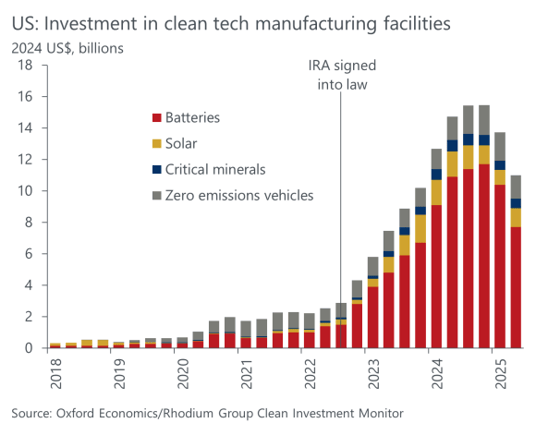
Both sources also address the slowing momentum behind recent U.S. manufacturing investments. Oxford Economics highlights that the surge in construction spending and policy-driven incentives during the Biden administration has begun to taper (see graph on the right). Kearney expands on this point by noting that heightened construction activity has not yet translated into proportional increases in domestic output due to persistent supply-side constraints such as extended project timelines, skilled labor shortages, and an underdeveloped domestic supplier base. Significant commitments in semiconductor and high-tech component facilities have yet to produce meaningful production capacity in the United States.
Labor shortages remain a critical barrier to reshoring success. Kearney reports that, for the third consecutive year, CEOs surveyed have identified labor cost and scarcity as leading challenges to reshoring and nearshoring efforts. Oxford Economics reinforces this observation by examining employment dynamics across manufacturing segments, noting that aerospace and battery-equipment jobs have increased while employment in automotive manufacturing, semiconductors, and pharmaceuticals has contracted in recent years.
More insights available in the full reports found below:


Oxford Economics' Prospects for US Reshoring of Manufacturing PowerPoint can be found on the Oxford Economics report NFPA page in the special reports section linked here. Kearney's 2025 Reshoring Index report can be found on the Business Intelligence reports NFPA page linked here.
For any questions regarding these reports, please contact Cecilia Bart at cbart@nfpa.com